Publication ListSimple list →
Upcoming ...
- , Kazuki Komatsu, Kenji Mochizuki, Hayate Ito, Koichi Momma, Shinichi Machida, Takanori Hattori, Kunio Hirata, Yoshiaki Kawano, Saori Maki-Yonekura, Kiyofumi Takaba, Koji Yonekura, Qianli Xue, Misaki Sato, and Hiroyuki Kagi. "New metastable ice phases via supercooled water". arXiv preprint, Submitted.
- and Stefan Klotz. Submitted.
- , Misaki Sato, Kazuki Komatsu, and Hiroyuki Kagi. Submitted.
- Xuejing He, Hiroyuki Kagi, Kazuki Komatsu, Ronald Miletich, Gerald Giester, Shengxuan Huang, , Sofija Miloš, Herta Effenberger, Satoshi Nakano, and Xiang Wu. Submitted.
- Zhongsheng Wei, Nicholas P. Funnell, Eddy Lelièvre-Berna, Sergio Federico Mayer, Stanislav Savvin, , Stefan Klotz, and Craig L. Bull. Submitted.
Structural Response of Laser-Driven Shock Compressed Albite
Geophysical Research Letters (2026) · DOI:10.1029/2025GL119542
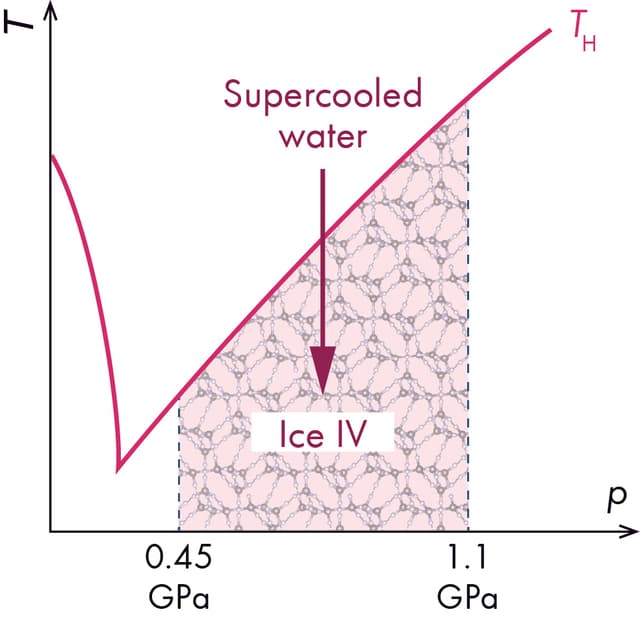
Ice IV from Supercooled Water: Reproducible Crystallization, Structure, and Ordering
The Journal of Physical Chemistry C 130 (25):8795–8805 (2026) · DOI:10.1021/acs.jpcc.6c00737
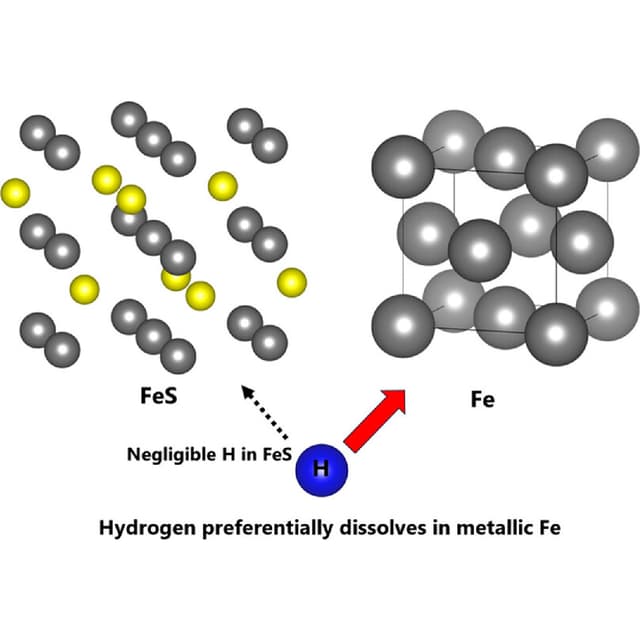
Negligible Hydrogen Solubility in FeS under High-Pressure and High-Temperature Conditions: Implications for Hydrogen Storage in Planetary Cores
ACS Earth and Space Chemistry 10 (4):1047–1061 (2026) · DOI:10.1021/acsearthspacechem.5c00326
Collaboration with Masahiro in the UTokyo group. We used x-ray/neutron diffraction, spectroscopy and theoretical calculations to show that the phase V of FeS cannot incorporate hydrogen at high pressures and temperatures, resolving recent controversies in the planetary science community.
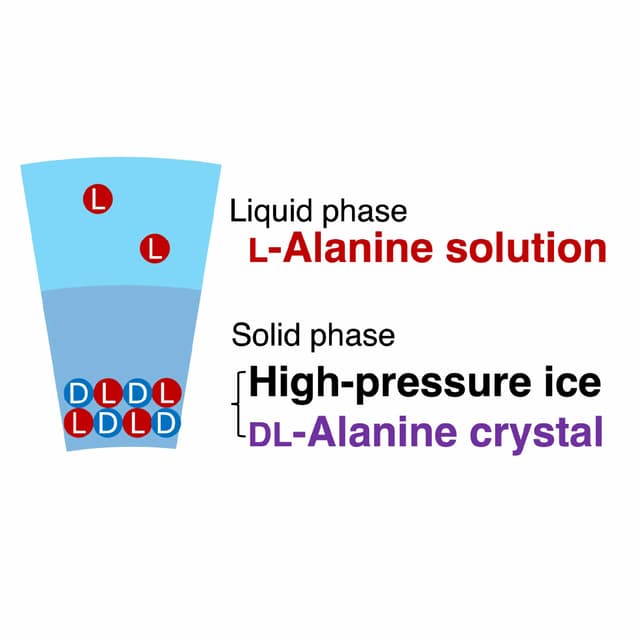
Enantiomer–Racemate Separation in Alanine Aqueous Solutions Triggered by Crystallization of High-Pressure Ice
ACS Earth and Space Chemistry 10 (3):678–686 (2026) · DOI:10.1021/acsearthspacechem.5c00300
Collaboration with Mika in the group. We show that the crystallisation of high-pressure ice may trigger enantiomer-racemate separations in freezing icy moons. Still far from strong astrobiological constraints on homochirality but I’m happy with the results where ice VI plays such a role!
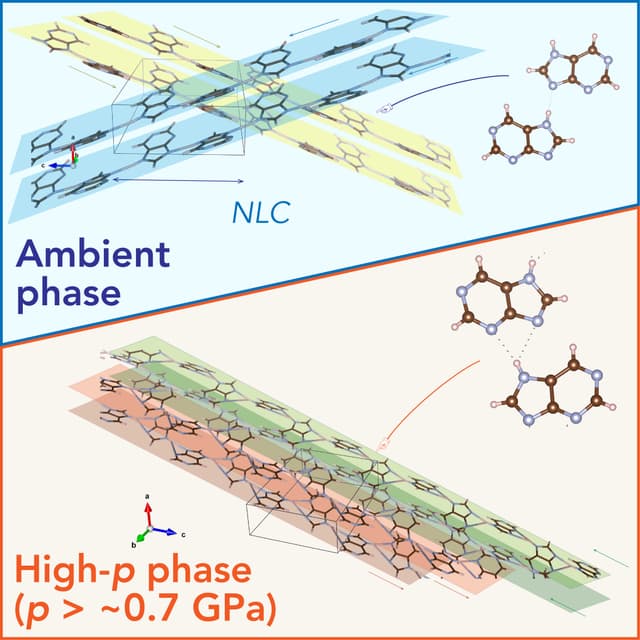
Densification processes of crystalline purine: Negative linear compressibility and pressure-induced phase transition
Chemical Physics Letters 884:142600 (2025) · DOI:10.1016/j.cplett.2025.142600
We studied pressure-induced structural changes in crystalline purine (C5H4N4). The ambient phase persists up to about 0.7 GPa until it transforms into a newly characterised high-pressure phase with a completely different packing structure. We pointed out that the intermolecular hydrogen bonds may be doubled, for which further spectroscopic/theoretical corroboration is desired. If so, we suggest this phase transition is characteristic in purine but not expected in pyrimidine, which has no ability to double the hydrogen bonds.
No long-range magnetic order in ε-iron down to 160 mK
Applied Physics Letters 127:211904 (2025) · DOI:10.1063/5.0299650
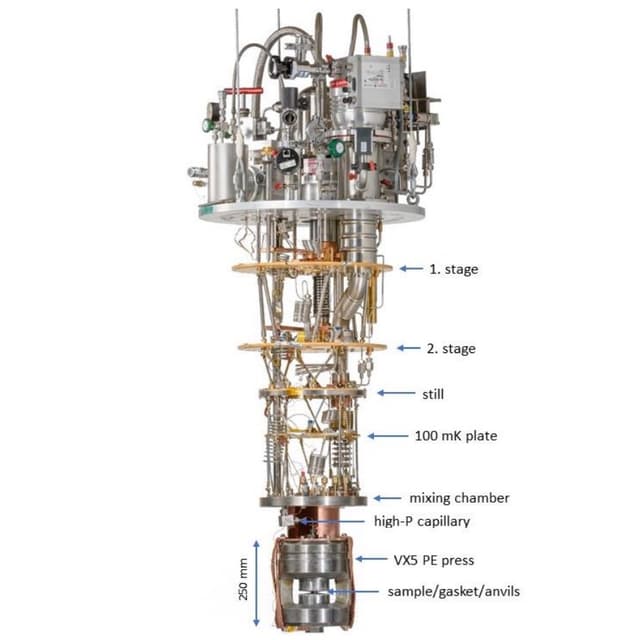
I helped with neutron diffraction experiments led by Stefan at XtremeD, ILL. We managed to measure diffraction patterns at 160 mK and 20 GPa, which is the lowest temperature record at this pressure. We report no evidence for a long-range magnetic ordering in hcp-Fe as suggested by some theoretical studies.
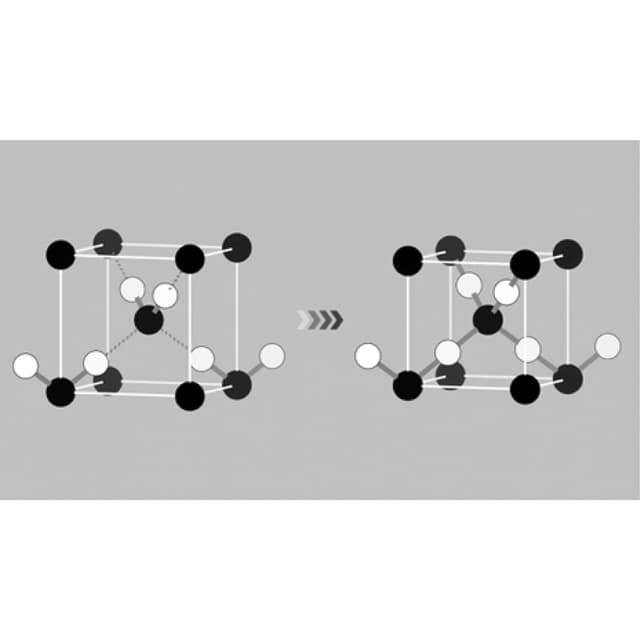
Hydrogen bond symmetrisation in D2O ice observed by neutron diffraction
Nature Communications 15:5100 (2024) · DOI:10.1038/s41467-024-48932-8
Project led by Komatsu san. We refined for the first time the hydrogen-atom position in ice VII (X) up to 106 GPa by in-situ powder neutron diffraction using nano-polycrystalline diamond anvil cells. I participated in experiments and discussion.
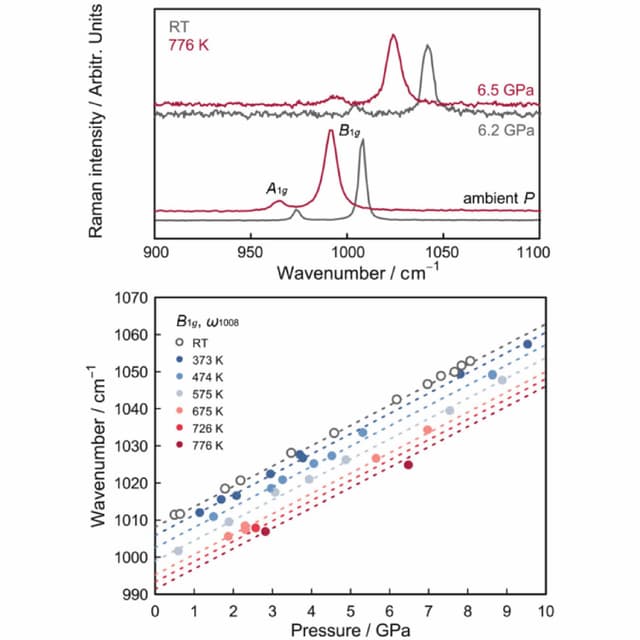
High-pressure and high-temperature Raman spectroscopic study of zircon as a pressure scale in hydrothermal DACs
Journal of Raman Spectroscopy 55 (6):706 (2024) · DOI:10.1002/jrs.6663
A collaboration with Naoko, we expanded the p-T region where the zircon Raman pressure scale is applicable. I mainly contributed to synchrotron x-ray diffraction measurements and analysis. Our x-ray diffraction results give a firm support to the previous work by Schmidt et al., with consistency to the standard primary pressure scale of gold.
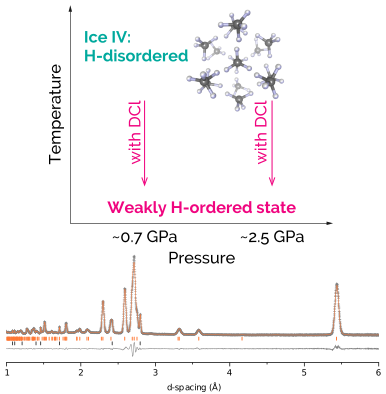
Slightly Hydrogen-Ordered State of Ice IV Evidenced by In-Situ Neutron Diffraction
The Journal of Physical Chemistry Letters 14:10664 (2023) · DOI:10.1021/acs.jpclett.3c02563
We reported crystallographic evidence for the hydrogen ordering in ice IV by neutron diffraction. It shows discontinuous behaviour at 120 K and Rietveld analysis at the low-T side suggests it is a very weak hydrogen ordering structural transition.
Ice IV, a metastable high-pressure phase of water nicknamed the "will-o'-the-wisp," has long lacked a reproducible synthesis route. We show that ice IV can be reproducibly crystallised from deeply supercooled water at the homogeneous nucleation temperatures using emulsified water. This work led to our important discovery of ice XXI-XXIII, and I’m happy to have finally published it.